Polypropylene (PP) Market Analysis
If the September PP market resembled a tense tug-of-war, then by October, one end of the rope was clearly pulling with greater force. However, this force originated upstream rather than downstream.
I. Costs: A fuse lit by geopolitics ⚡
The October PP market opened with a whiff of gunpowder. Geopolitical jitters regarding Middle East shipping pushed crude oil prices back to highs; when crude oil “coughs,” the entire PP supply chain catches a “cold.” From naphtha to propylene, and from ethylene to polyolefins, the cost base has been steadily raised layer by layer.
Propane stands out as the most glaring issue. PP plants relying on propane dehydrogenation (PDH) have been struggling lately—the cost of raw materials has surged faster than the selling prices of finished products. Caught in a squeeze, they face skyrocketing feedstock costs on one side and downstream buyers unwilling to readily accept goods on the other. Put simply, the market isn’t driven by robust demand, but by expensive raw materials.
II. Supply: The “short-term pain” of maintenance vs. the “long-term worry” of new capacity 📦
Currently, many PP plants are undergoing maintenance; supplies are not abundant, allowing spot prices to hold firm. This represents the “short-term pain.”
Looking ahead, however, a wave of new capacity is lined up to come online in the fourth quarter. A pattern of “near-term tightness and long-term looseness” is all but certain. This is the “long-term worry.”
A familiar scenario in the PP market is playing out once again: price spreads reflect anxiety about future supply. The current tightness is temporary; future oversupply is the expected norm.
III. Demand: The “real-world feel” in BOPP and PP films 🛒
Despite years of hype surrounding the “Golden September, Silver October” peak season, this year’s September failed to live up to the “Golden” label.
This sentiment is particularly palpable in downstream sectors such as BOPP film and PP film manufacturing. Operating rates across the woven bag, injection molding, and film sectors remain lackluster. BOPP film manufacturers are purchasing raw materials piecemeal to cover specific orders, while PP film processors are pacing their buying carefully; no one wants to shoulder the burden of holding inventory. Their mindset is pragmatic: if raw material prices rise, they buy less; if finished goods aren’t moving, they are even more reluctant to stockpile.
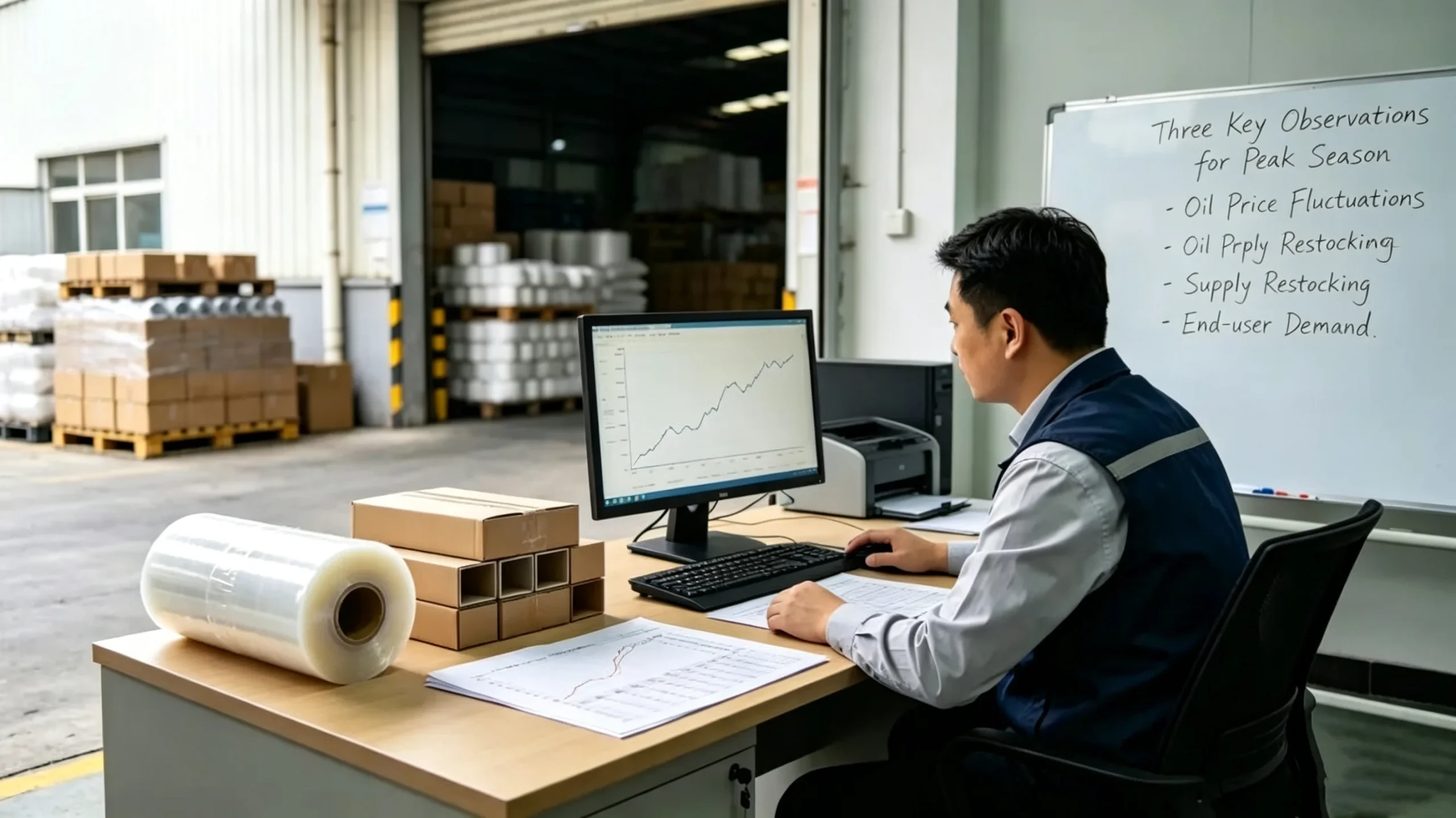
The peak season has failed to live up to its name, and the demand side has consistently failed to pick up the baton. Upward price movements are largely propped up by cost pressures rather than being driven by a surge in orders.
IV. Inventory and Price Spreads: The Market’s Thermometer 🌡️
Near-term contracts are expensive while far-term contracts are cheaper, creating a widening price spread—a market signal pricing in “current tightness” versus “future looseness.” Meanwhile, inventory flows quietly tell the story: goods are moving into warehouses rather than into production workshops.
As polypropylene (PP) piles up in the middle of the supply chain instead of being consumed downstream, the market remains in a “wait-and-see” mode.
V. Assessment: Cost Support vs. Demand Drag ⚖️
In the short term, as long as crude oil prices and geopolitical tensions remain high, PP prices will find support, tending to trade at the upper end of their range—prone to rising but resistant to falling. However, without strong demand, these gains struggle to turn into a sustained trend; once cost support wavers, pullbacks tend to be swift and decisive.
On a deeper level, the PP market is still grappling with the “aftereffects” of the massive capacity expansion seen in previous years. Oversupply remains the long-term backdrop, while cost fluctuations are merely intermittent episodes. Whether the price level can truly stabilize depends ultimately on the progress of supply-demand rebalancing.
VI. A Word to Peers in the BOPP and PP Film Industries 💡 
Those of you in the BOPP film, PP film, and packaging film sectors likely share the same sentiment lately: film prices track raw material costs, yet end-customers refuse to accept the pass-through. Costs push upward while finished product prices fail to keep pace, quietly eroding profit margins in the process. Rather than betting on market direction, focus on managing the pace of operations. Align procurement with the rhythm of incoming orders to lock in costs for future months; leave uncertainty to the market while securing certainty for yourself.
For the polypropylene (PP) market in October, what is needed most may not be courage, but patience.
Ultimately, the October market for PP is a tug-of-war characterized by “upstream price hikes versus downstream hesitation.” Whether dealing with BOPP film or other polypropylene films, the first mover risks being put at a disadvantage. Everyone is waiting for a signal—either a retreat in crude oil prices or a pickup in orders.
Until then, maintaining a steady pace is the best strategy.
💡Recommended related products: heat-sealable-film
If you want to learn more about our products, you can find out more through Facebook